
Introduction
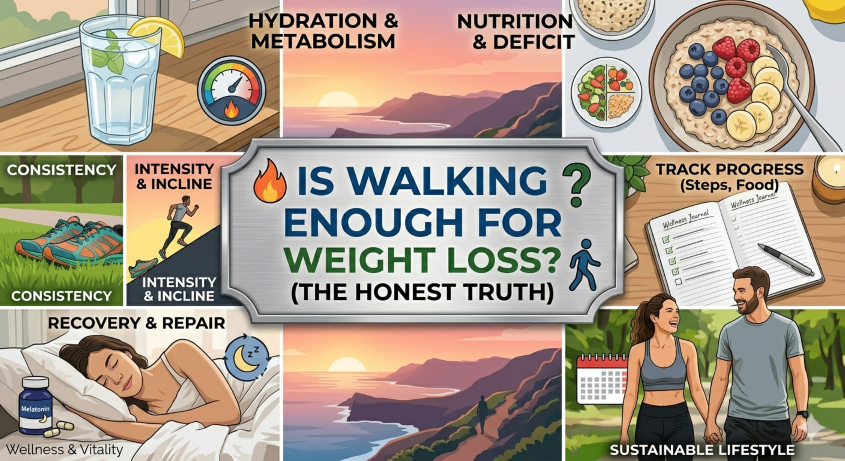
Walking is probably the most underrated “super-exercise” in existence. It’s free, you don’t need a fancy spandex outfit, and you can do it while listening to your favorite podcast. But when the goal is specifically weight loss, a nagging question always comes up:
“Is just walking… enough for weight loss?”
We’ve all been told to hit that magical 10,000-step number. We know it’s good for our hearts and our heads. But will it actually help you fit into those jeans that have been sitting in the back of your closet for two years? Can you really skip the grueling gym sessions and just… walk?
The short answer is yes—but there’s a catch. Walking can shrink your waistline, but only if you stop treating it like a casual stroll and start treating it like a strategy. Let’s look at the science of how to make your daily steps actually pay off.
How Does Walking Actually Burn Fat?
Before we talk about “enough,” let’s talk about how it works.
When you start walking, your body first burns through the “easy fuel” (carbohydrates). But after about 20–30 minutes of steady movement, your body flips a switch. It starts tapping into your “long-term storage”—your body fat.
This is the fat-burning zone.
- The Sweet Spot: You’re in this zone when your heart rate is at about 50–70% of its max.
- The “Talk Test”: If you can still hold a conversation but you’re a little too breathless to sing your favorite song, you’re exactly where you need to be.
Unlike a high-intensity workout that burns a lot of “sugar” quickly, walking is a slow, steady fat-melting process. It’s the “tortoise” in the race to weight loss.
The Brutal Calorie Math
Weight loss is ultimately a math problem: a calorie deficit. To lose one pound of fat, you need to create a deficit of roughly 3,500 calories.
Here is what that looks like for a 155-lb (70 kg) person:
- 30 Minutes: ~130 calories (Basically one large apple)
- 60 Minutes: ~270 calories (A small latte)
- 10,000 Steps: ~400 calories (A blueberry muffin)
The Reality Check: It is incredibly easy to “eat back” your walk. If you finish a 5-mile walk and “reward” yourself with a flavored coffee and a snack, you haven’t just erased the walk—you might actually be in a surplus.
Personal Tip: Think of walking as a way to increase your budget, not as a reason to spend it immediately.
How Many Steps Do You REALLY Need?
That 10,000-step goal? It actually started as a 1960s Japanese marketing campaign, not a medical requirement. However, for weight loss, it’s a great baseline.
If you want to see the scale move, here is the hierarchy:
- Sedentary: Under 5,000 steps (Maintenance is hard here)
- Active: 10,000 steps (The “Gold Standard” for health)
- The Weight Loss Zone: 12,000–15,000 steps.
A study in the journal Obesity found that people hitting 12,000+ steps daily saw significant weight loss compared to those who just did the bare minimum.
Don’t panic: If you’re at 3,000 today, don’t try for 12,000 tomorrow. Your feet will hate you. Add 1,000 steps every few days. Progress, not perfection.
Why Your Walking Might Have Stopped Working
If you’ve been walking for weeks and the scale hasn’t budged, you’ve likely hit one of these “invisible walls”:
- The Adaptation Trap: Your body is smart. If you walk the same 2-mile flat loop every day at 6 PM, your body becomes efficient at it. You actually start burning fewer calories because your body has mastered the route.
- The “Hidden” Calories: You’re eating just a little bit more because walking makes you hungry. Those extra bites at dinner add up.
- The Muscle Fade: Walking doesn’t build much muscle. And since muscle burns more calories at rest than fat does, you want to keep as much of it as possible.
4 Ways to “Turbo-Charge” Your Walk
If you want walking to be your main tool for weight loss, you have to upgrade it:
- Find a Hill: Incline walking is a game-changer. Walking at a 5% grade burns roughly 50% more calories than walking on flat ground. It’s also better for your glutes!
- Intervals: Walk like you’re late for a meeting for 2 minutes, then stroll for 1 minute. Repeat. This “spikes” your heart rate and forces your body to work harder.
- The “Fasted” Walk: Try walking first thing in the morning before breakfast. With your “easy fuel” (carbs) low from sleeping, your body is forced to look at your fat cells for energy.
- The Power of 20: Add just 20 minutes of simple bodyweight moves (squats or lunges) twice a week. This protects your muscle while the walking burns the fat.
Your Weekly “Fat-Burn” Walking Plan
| Day | Goal | Strategy |
| Monday | 8,000 Steps | Consistent, moderate pace. |
| Tuesday | 10,000 Steps | Interval Day: 10 mins fast, 5 mins slow. |
| Wednesday | 7,000 Steps | Easy recovery walk. Focus on posture. |
| Thursday | 12,000 Steps | Hill Day: Find a local slope or use treadmill incline. |
| Friday | 8,000 Steps | Brisk walk before lunch. |
| Saturday | 14,000 Steps | The “Adventure Walk.” Long, steady duration. |
| Sunday | 5,000 Steps | Leisurely family walk or window shopping. |
The Verdict: Is It Enough?
Walking IS enough if:
- You are consistent (6–7 days a week).
- You hit 10k–12k steps regularly.
- You are honest about your diet (you can’t out-walk a bad diet!).
Walking IS NOT enough if:
- You have a very large weight loss goal (50+ lbs) and want fast results.
- You ignore your nutrition entirely.
- You never change your pace or terrain.
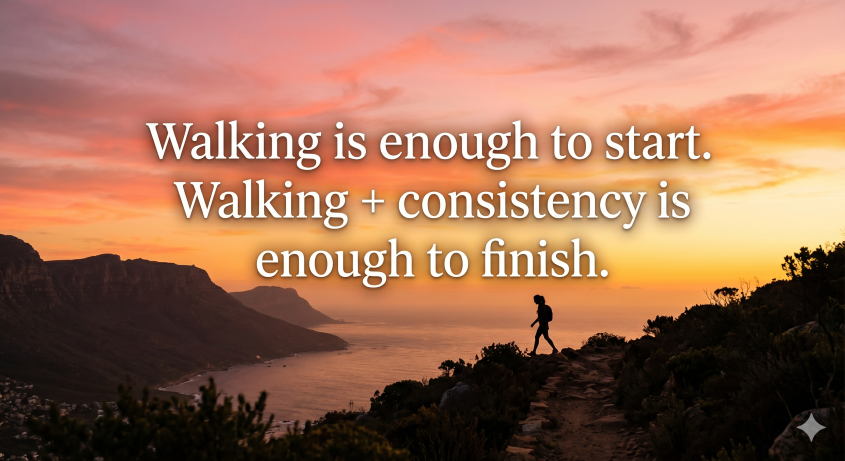
My Final Thoughts: Walking is enough to start. It’s enough to build a habit. And for many of us, it’s enough to transform our lives—provided we stay consistent and keep our eyes on the “calorie math.”
Stop waiting for the “perfect” gym routine. Put on your shoes. Step outside.Which hill are you going to conquer today? Let me know your step goal in the comments!