
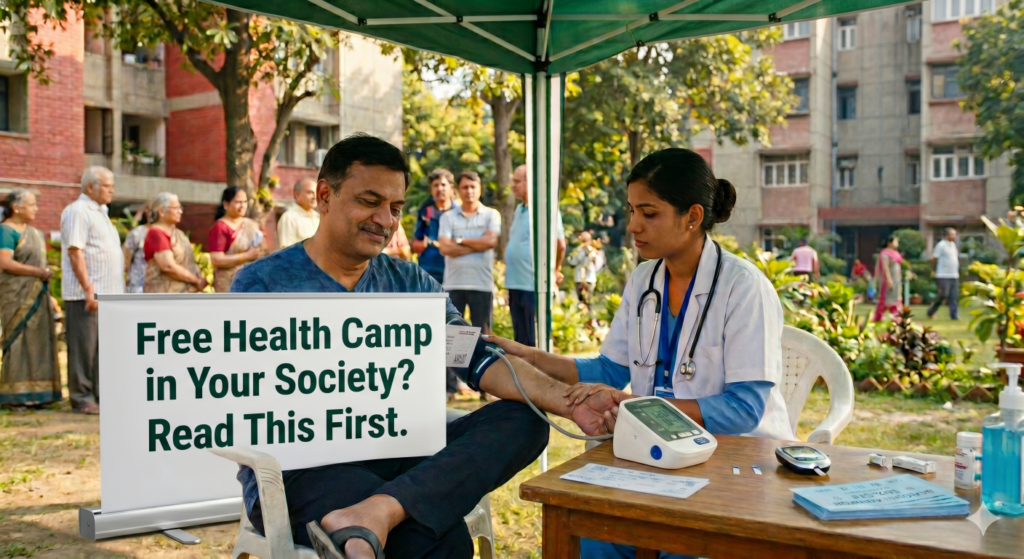
Free Health Checkup: Blessing or a Hospital Trap?
It was a typical Sunday morning. I was in my kitchen, arguing with my coffee machine, when my doorbell rang.
It was Mrs. Sharma from the 3rd floor. She was holding a small white slip and looked slightly anxious. “Beta, there is a free health camp downstairs. They are giving ECG for free. And discount coupons also. Should I go? Last time I went to such camp, they told me I have thyroid and I ended up spending ₹4000 on tests.”
I smiled, turned off my coffee machine, and walked down with her. That morning, standing under that green canopy, watching my neighbours queue up in their slippers, I realized something: Every single person there had the same question.
Is this a blessing or a trap?
Today, let me answer that question for you—not as a doctor, but as a resident who has stood in that line, taken that discount coupon, and learned the hard way.
My Personal Story: The Coupon I Almost Fell For
Let me be honest with you.
Two years ago, a famous multispecialty hospital set up a camp in my society. I was feeling perfectly fine. But free tests? I love free things. So I sat down. They pricked my finger. The random blood sugar came back: 142 mg/dL.
The volunteer looked at me with a serious face. “Sir, borderline. You need a full HbA1c test. Normally ₹800, but today we have a special offer—just ₹400 with this coupon.”
My heart skipped a beat. Diabetes? Me? I took the coupon. I almost walked straight to my car to drive to the hospital.
But something stopped me. I remembered that my regular family doctor, Dr. Mehta (a simple man in a small clinic near the market), had once told me: “Ankit, never panic on a single random reading.”
So I did something simple. The next morning, fasting, I went to Dr. Mehta’s lab. Paid ₹150 for a fasting sugar test. Result: 88 mg/dL. Perfectly normal.
That discount coupon went into the dustbin. And I learned my lesson.
That is why I am writing this for you today. Not to scare you away from camps. But to help you use them without getting scammed.
The Dual Reality: Two Sides of the Same Stethoscope
So let me tell you the truth, friend to friend.
Yes, hospitals use these camps for promotion. I am not naive. They want your phone number. They want you to walk through their doors. That discount coupon? It is a hook. They are fishing for patients.
But also yes, these camps can save lives. I have seen it. My own uncle, a healthy 62-year-old who never went to doctors, attended a free camp last year. His BP was 170/100. He had no symptoms. That camp sent him to a physician. Today, he takes one small tablet daily, and his BP is controlled. Without that random Sunday camp? Maybe a stroke. Maybe worse.
So here is my take: It is both. A blessing and a promotion. A gift and a sales pitch.
Our job as smart residents? Take the blessing. Leave the trap.
Is It Beneficial for Residents? (From Someone Who Has Been There)
After attending four such camps in the last three years (yes, I am that curious), here is my honest verdict:
It is beneficial IF you treat it as a rough screening, not a final diagnosis.
The Good (What I Love About These Camps)
- Zero pressure on your pocket. Not everyone can afford a ₹1000 preventive health package. A free sugar and BP test? That is accessibility. That is good for the community.
- Convenience is king. I don’t have to take a half-day off, drive through traffic, and sit in a waiting room for two hours. The camp comes to my building’s garden. I can go in my chappals.
- It breaks our laziness. Let’s be honest. We all know we should check our BP. But we keep postponing. A camp forces a moment of accountability.
The Bad (What I Have Personally Witnessed)
- The machines are not lab-grade. Those portable glucometers? They can have a 10-15% error margin. I once saw a neighbour get a sugar reading of 180 on the camp machine, then 125 on a lab machine the same afternoon. Imagine the panic.
- The “doctor” may be a salesperson. I am not disrespecting medical professionals. But at some camps, the person interpreting your report is a marketing executive wearing a borrowed white coat. Ask for their credentials. Politely.
- The coupon creates false urgency. “Valid only for 48 hours!” I have seen this trick. Fear plus a deadline equals bad decisions.
The Infamous Discount Coupon: My Personal Rule
You mentioned discount coupons in your question. Let me share my golden rule.
Take the coupon. Smile. Say thank you. Then go home and sleep on it.
Do not—I repeat, do not—drive to the hospital the same day.
Here is what I do now:
- Get the camp results on a piece of paper.
- Take the coupon (even if it is 50% off).
- Go home. Relax.
- The next day, visit my regular local diagnostic center (the one I trust, not the hospital’s lab).
- Pay full price (usually ₹100-200 for a sugar or lipid test).
- Compare the results.
If both match? Then the camp was accurate. Good. Now I know my numbers. And I still don’t have to buy their expensive package.
If the local lab says something different? Then I just saved myself from a wrong treatment plan.
That coupon? I keep it only for a test I was already planning to do. Otherwise, it goes into the recycling bin.
Red Flags I Have Personally Seen (Watch Out!)
Let me share three real things I have witnessed in my own society camps:
Red Flag #1: No Printed Report
A volunteer wrote my friend’s BP on a sticky note. When my friend asked for a printed copy, the person said, “That will only be given at the hospital.” Run. They are holding your data hostage to force a visit.
Red Flag #2: The Upsell After a Normal Result
My neighbour’s sugar was 92 (perfectly normal). Yet the camp “counsellor” told her, “Madam, normal is 70-100. You are close to 100. You should take our diabetes prevention package for ₹5000.” That is fear-mongering. Walk away.
Red Flag #3: Only Expensive Scans for Free
Some camps offer “free ECG” but charge for basic BP and sugar. Think about it. An ECG is expensive. Why give it free? Because they are looking for heart patients. If they find even a minor irregularity, they will push for angiography. Be very careful.
The Smart Resident’s Playbook (What I Follow Now)
After my own close call with that ₹400 HbA1c coupon, I made a simple playbook. Follow this, and you will never regret attending a camp:
Step 1: Go at the end time.
Don’t go at 9 AM when the camp starts. Go at 11:30 AM (if it ends at 12 PM). The crowd is gone. The aggressive salespeople are tired. You will get calmer, faster service.
Step 2: Leave your wallet upstairs.
I am serious. Carry no cash, no card, no UPI app open. You cannot buy anything if you have no money with you. This is my favourite trick.
Step 3: Ask one simple question.
Before they prick your finger, ask: “Will you give me a printed report with your hospital letterhead right now, for free?”
If they say no, stand up and leave. If they say yes, sit down.
Step 4: Thank them and walk away.
After getting your numbers, smile warmly. Say “Thank you so much for your service.” Then walk away. You do not owe them a conversation. You do not owe them a booking.
Step 5: Text a family member.
Immediately after the camp, WhatsApp your results to your spouse or a trusted friend. Why? Because if a number is off, you now have a witness. You are less likely to panic-buy a test package.
The Final Answer: Should You Go? (My Honest Recommendation)
So, back to the question Mrs. Sharma asked me that Sunday morning.
“Beta, should I go?”
My answer today is the same as it was then.
Yes, Mrs. Sharma. Please go. Get your BP and sugar checked. It is free. It is convenient. And it might just catch something important.
But here is what I also told her.
“Mrs. Sharma, do not take your purse. Do not book any test on the spot. Take the coupon, fold it, put it in your sari pallu, and come home. We will call Dr. Mehta tomorrow and decide together.”
She smiled. She went. Her numbers were normal. She came home, made tea, and we laughed about the salesperson who tried to sell her a “detox package.”
That is what I want for you, dear reader.
Go for the free data. Not for the free stethoscope. Not for the discount coupon.
Use the camp as a flashlight in a dark room—it shows you where the furniture is. But to rearrange the room? Call your trusted family doctor.
Hospitals are businesses. Your health is not.
So be polite. Be grateful. But be smart.
Now tell me—have you ever had a scary moment at a free health camp? Or did one actually save your life? I would genuinely love to hear your story in the comments below.
Stay healthy. Stay skeptical. Stay in control.
Disclaimer: This blog post is based on personal experiences and research. It is not medical advice. Always consult a qualified doctor before making any health decisions.