
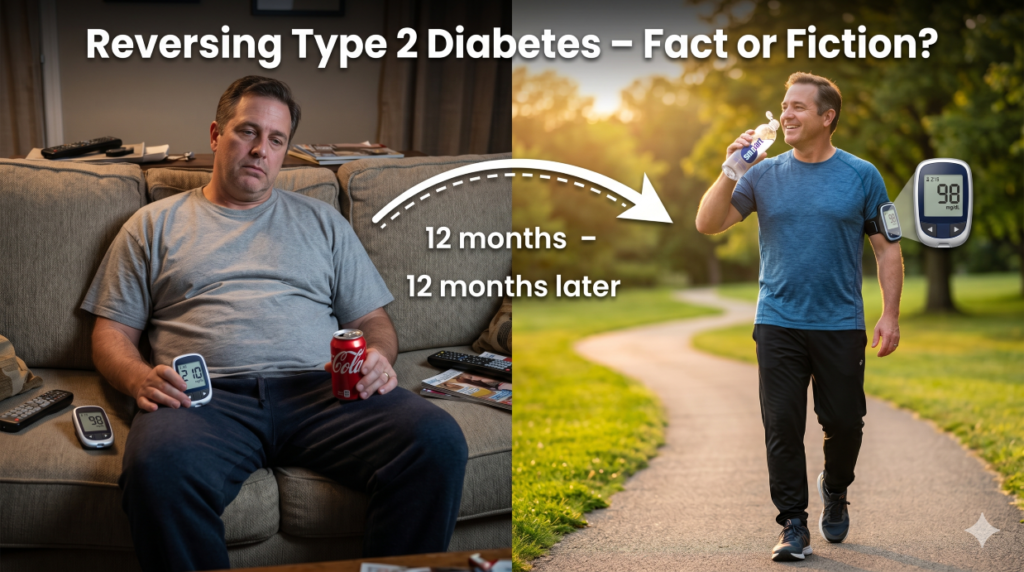
You have probably seen the claims online.
“Reverse your diabetes in 30 days!” “Doctors hate this simple trick!” “I cured myself naturally – and so can you!”
Then you go to your doctor, and they say: “Diabetes is chronic. You will have it for life.”
So who is right?
After reading through the actual medical research, I found that both sides have some truth. But what matters most is understanding type 2 diabetes remission – what it really means, who can actually do it, and how to get there without falling for fake cures.
First, let us stop using the word “reversed”
Doctors do not say reversed. They say remission. And this is not just a small word game. The difference matters a lot. So when someone says they “reversed” their diabetes, what they usually mean is they achieved type 2 diabetes remission. Their blood sugar looks normal without medication. But the tendency for high blood sugar is still there in the background.
What does type 2 diabetes remission actually look like?
If you achieve remission, here is what changes in your daily life:
- You stop taking diabetes medications – no metformin, no insulin, no shots at all
- Your morning blood sugar stays below 100 mg/dL (or 5.6 mmol/L)
- Your A1C (the three-month average) stays below 6.5% for at least three months in a row
- You eat normal food – not just shakes and salads – but you have to be smart about your choices
That sounds pretty good, right? But here is the honest catch. That remission can disappear if you regain weight or go back to old eating habits for too long. It is not a permanent free pass.
So can you actually achieve type 2 diabetes remission? (The real science)
Yes. But not everyone. And definitely not without real effort.
A major study called DIRECT looked at this carefully. Researchers put people with diabetes on a low-calorie diet under medical supervision. Here is what they found about weight loss and type 2 diabetes remission:
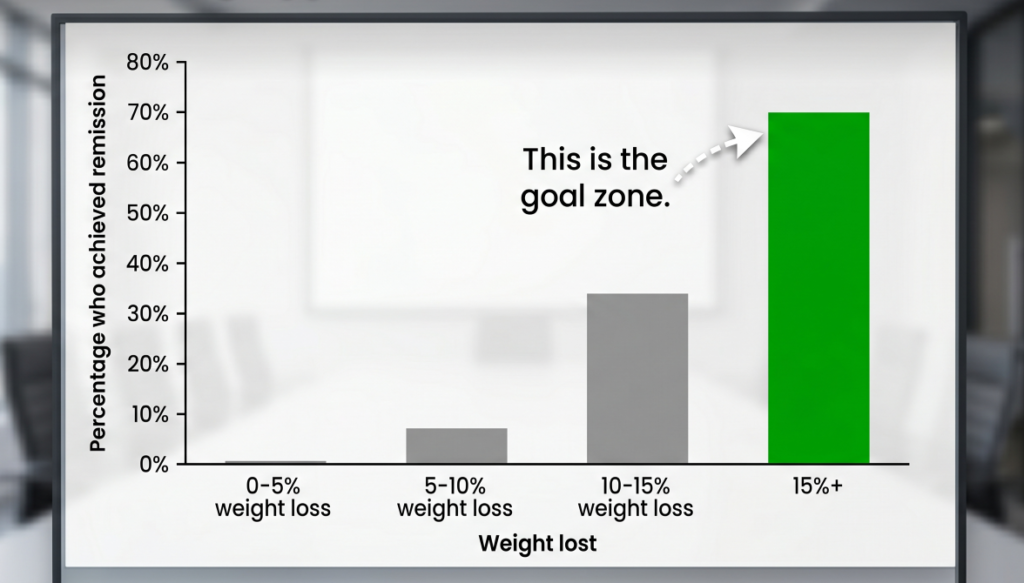
Losing 15% or more of your body weight gives you the best chance at remission. Let me give you a real-life example so it makes sense. If you weigh 200 pounds (about 90 kilograms), you need to lose 30 pounds (14 kilograms) to have a strong shot at type 2 diabetes remission. Losing five or ten pounds helps your health, sure. But it rarely gets you off all medications.
Who is most likely to achieve remission? (Be honest with yourself here)
Not everyone with Type 2 diabetes is a good candidate for remission. But if most of these points sound like you, your chances are actually pretty good.
You are a good candidate for type 2 diabetes remission if:
- You were diagnosed less than six years ago
- Your current A1C is below 8%
- You are overweight (this matters a lot – remission is hardest for people who are already at a normal weight)
- You do not take daily insulin yet
- Your pancreas still makes some insulin (your doctor can run a simple blood test called C-peptide to check this)
You will struggle to achieve remission if:
- You have had diabetes for more than ten years
- Your pancreas makes very little insulin anymore
- You are already at a normal body weight (your diabetes likely has a different cause)
- You have been on high-dose insulin for years
The golden rule I have learned from reading the research is this: the earlier you act after diagnosis, the better your chance at type 2 diabetes remission. Every year you wait, it gets harder. But it is rarely completely impossible.
How do you actually get there? (Step by step, no fluff)
No magic teas. No expensive supplements. No 30-day challenges that promise the world and deliver nothing. Here is what actually works for type 2 diabetes remission.
Phase 1: The jumpstart (8 to 12 weeks)
- Eat between 800 and 1,200 calories per day
- Use liquid meal replacements like shakes, soups, or protein bars – this makes it easier to stick to the plan
- Do this only with a doctor watching over you – please do not guess on your own, especially if you take insulin
- Goal: lose 10% to 15% of your body weight fairly quickly
This phase is not forever. Think of it as a reset button for your pancreas. You are giving your body a break from storing fat inside the pancreas, which helps the insulin-producing cells wake back up.
Phase 2: The everyday plate (for life)
After you lose the weight, you cannot go back to how you used to eat. That is why most people relapse. Here is your new normal plate, and it is actually pretty simple to remember:
- Half the plate = non-starchy vegetables (broccoli, spinach, cauliflower, zucchini, peppers, cucumber)
- One quarter of the plate = lean protein (chicken, fish, eggs, tofu, lentils, beans)
- One quarter of the plate = smart carbs (quinoa, barley, small apple, handful of berries, sweet potato with skin)
- A thumb-sized amount = healthy fat (olive oil, avocado, nuts, seeds)
That is it. No counting every single gram of carb. Just a simple visual guide you can use at any restaurant or at home.
Phase 3: Move your body (no gym membership required)
- Walk briskly for 30 minutes, five days a week – just walking is genuinely enough
- Do bodyweight exercises like squats or push-ups for 20 minutes, two days a week
- Park farther from the store. Take stairs instead of elevators. Stand up every hour if you have a desk job.
Small things add up over time. You do not need a personal trainer or an expensive gym membership to achieve type 2 diabetes remission. You just need consistency.
The honest truth no one likes to talk about
Type 2 diabetes remission is not a cure. It is more like tending a garden. You cannot plant it once and walk away forever. You have to water it every single day.
Here is what happens to most people who achieve remission:
- If you keep the weight off and eat well → remission stays for years, sometimes even decades
- If you regain 10 to 15 pounds → blood sugar starts creeping back up slowly
- If you go back to soda, white bread, and sitting all day → diabetes returns fully within months
One study followed people who had achieved type 2 diabetes remission. After two years, more than half had lost their remission. Not because the method failed. Because they slowly slipped back into old eating habits. That sounds discouraging, I know. But here is the other side: the people who kept the weight off stayed in remission. It is completely possible. It is just not automatic.
Type 2 diabetes remission: Fact or fiction? Let me sum it up
| Claim | Fact or Fiction? | What You Need to Know |
| You can cure diabetes forever with a 30-day juice cleanse or a special tea. | Fiction | No quick fix or detox can cure diabetes. Sustainable weight loss and lifestyle changes are what matter. |
| You can achieve type 2 diabetes remission (normal blood sugar without medication) if you lose 15% or more of your body weight and keep it off. | Fact | Remission is possible—but it requires significant, maintained weight loss, typically through diet and sometimes medical support. |
| Everyone with Type 2 diabetes can reverse their condition. | Fiction | Remission is most likely for people diagnosed early (within six years) who are overweight. Those with diabetes for 15+ years may not achieve remission. |
| Once you are in remission, you can eat whatever you want again with no consequences. | Fiction | Remission isn’t a free pass. It requires lifelong smart eating and regular activity. Slip too far for too long, and diabetes can return. |
The bottom line (if you take away one thing, let it be this)
If you were recently diagnosed with Type 2 diabetes and you carry extra weight, please do not lose hope. You have a real shot at type 2 diabetes remission.
But you need to act now. Not next year. Not “someday when I have more time.”
- Lose 15% of your body weight (30 pounds if you weigh 200 pounds)
- Work with a doctor to safely do a short-term low-calorie phase
- Fill half your plate with vegetables for the rest of your life
- Walk 30 minutes a day, most days of the week
No lies. No magic. Just science and daily consistency.
And one day, your doctor might look at your blood work, pause, and say: “Your numbers are completely normal. Let us try stopping your medications.“
That is not a permanent cure. But for most people living with diabetes, it feels close enough to a miracle.
Frequently Asked Questions about type 2 diabetes remission
- Can type 2 diabetes go into remission permanently? – It can last for many years if you maintain weight loss and healthy eating habits. But if you regain weight or go back to old patterns, it can return. Think of it like a garden that needs daily care.
- How much weight do I need to lose for type 2 diabetes remission? – Research shows losing 15% or more of your body weight gives you the best chance. For a 200 pound person, that means losing 30 pounds.
- Can I reverse diabetes after 10 years? – It becomes harder the longer you have diabetes. People diagnosed within the last 6 years have the highest success rates. But some people with longer duration have achieved remission, especially if they still produce some insulin.
- Is diabetes remission the same as being cured? – No. A cure means the disease is gone forever. Remission means it is not active right now but can return if you stop your healthy habits.
- Do I need to follow a very low calorie diet forever? – No. The low calorie phase is only 8 to 12 weeks to jumpstart weight loss. After that, you switch to the sustainable plate method with real food.
Disclaimer: This article is for informational purposes only and does not replace medical advice. Always talk to your doctor before making significant changes to your diet, medications, or exercise routine, especially if you take insulin or other diabetes medications. Do not stop or change your medications without medical supervision.
| Word | What it actually means |
| Reversed | Gone forever. Will never come back. Like a broken bone that heals completely. |
| Remission | Not active right now. Can return if you stop your healthy habits. Like cancer remission. |